Sunday, December 19, 2010

The name Reinhard

Oh, the internet is AMAZING when you want to know about something.....

Tonight, I came across a reference to Reineke Fuchs,  (Reynard the Fox), described on Wikipedia as an "old allegorical French, Dutch, English and German fable largely concerned with Reynard, an anthropomorphic red fox and trickster figure".     My antenna twitched cuz mom's gramma was Franziska FUCHS, and mom's brother was REINHARD...hmm, there might have been some sort of influence there, however subtle.  The Reineke Fuchs stories were popular for centuries in Germany.
So.  Reineke Fuchs "became throughout the 16th century within the German-speaking countries a bestseller.  It is the story of the mean, smart fox who always succeeds with his lies and triumphs in the end over his opponents".  Our parents didn't encourage "meanness"  or lying, but cleverness thru a bit of deceit was definitely admired.  And, no, they never read these stories to us ☺

Oh, and Wikipedia talks about the origins of REINHARD thusly:
  Theories about the origin of the name Reynard are:
  • From the Germanic man's name Reginhard, which came from 'regin' = "the divine powers of the old Germanic religion" and "hard": "made hard by the gods", but with the disuse of the old Germanic religion was later likely interpreted as "rain-hard" meaning "staying steady under a rain of blows from weapons in battle" or similar.
  • From the Germanic man's name Reginhard (later condensed to Reinhard), which comes from 'regin' = "counsel" and 'harti' = "strong", denoting someone who is wise, clever, or resourceful".
You're welcome!

Sunday, December 12, 2010

Info from Obituaries

Two obituaries from  Iowa in 1915 and 1944.  Margaret Kauper Naber was the wife of Henry Naber, who was the half-brother of  great grandfather Gerhard Naber.  (Henry's mom was Elizabeth Rupipper, and Gerhard's mom was Elizabeth Richels).  But look what other info is included--she was born in Lohn, Hanover, Germany, which leads us to look in that area for Nabers, too, since immigrants tended to settle in the new world near people they knew in the old.  It turns out that Henry died exactly a year before two of his half sisters Mary Schlichte and Grandma Margaret Janson. (They both died in April, 1945).
This below is just a sweet bit of daily life on the Naber farm in Bancroft, Iowa.  The reporter was a friend, you can tell, and he probably got supper out of the deal that day, too...lol
(BTW, Larry said the woman mentioned, "Mrs Jos. Baltz" was the former Clara M. Raskoff (1872-1956), just so we know ☺).


On the left is Henry Naber with his daughter Walburga, and on the right, Henry with daughter Ida.  Below is a young Reinhard Janson with the sisters, probably in Bancroft, probably in the 1940s.


THANKS for searching newspapers, Larry! ☺

Friday, December 3, 2010

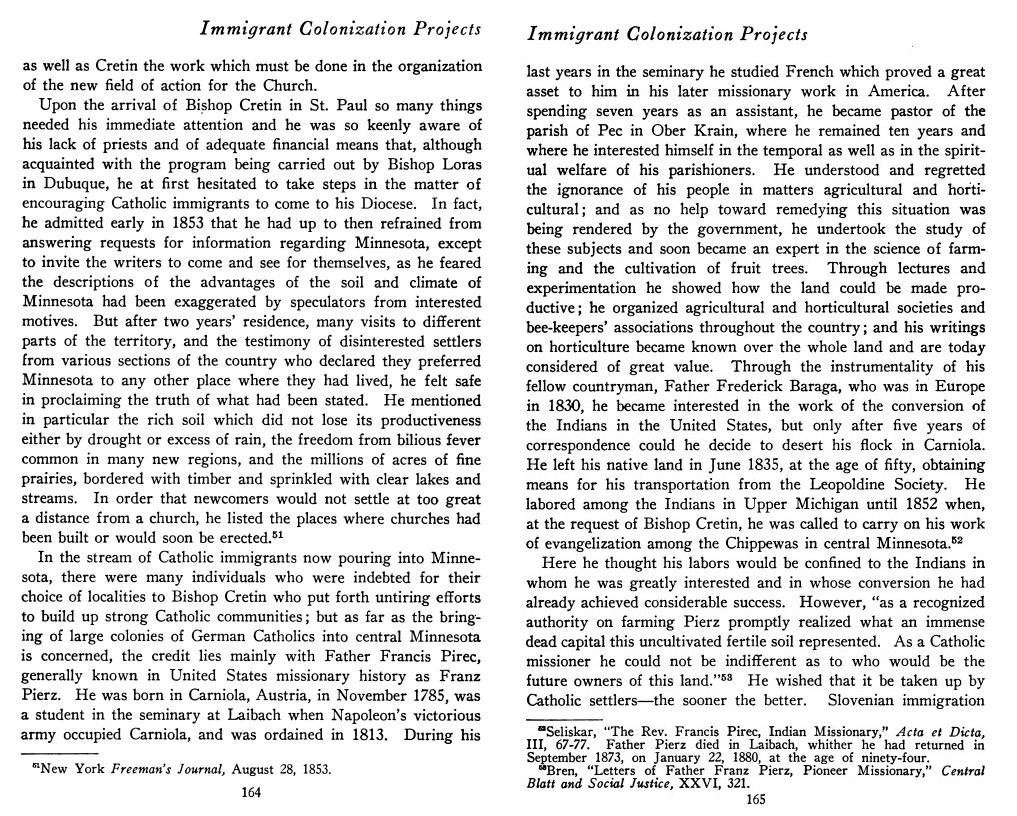
Fr Francis X. Pierz


This ► book was published in 1939, and it's a pretty clear history of how and why Catholic immigrants settled where they did .  A few pages have to do with Fr Pierz and the German settlers he encouraged to come to Minnesota.  The pages below are an interesting read because the grade school info we got from the nuns is only part of the story...it's well worth the time, trust me...☺


::::::::::::::::1:::::::::::::::::

::::::::::::::2::::::::::::
:::::::::::::::::3:::::::::::::::
:::::::::::::::::4:::::::::::::::
:::::::::::::::::::5:::::::::::::::::::

Sunday, November 28, 2010

The State Normal School @ St Cloud

On Thanksgiving, we were talking about how much debt students today are graduating with, a conversation that brought this 1910 ad to mind... 


Probably anyone who knows St Cloud knows SCSU (St Cloud State University), and that it began as something called a "Normal School".  According to wikipedia, "A normal school was a school created to train high school graduates to be teachers. Its purpose was to establish teaching standards or norms, hence its name".

Imagine-- "Tuition is free to all who pledge themselves to teach at least two years in the state".  Wow.


(You're welcome...☺)

Thursday, November 18, 2010

The other Jansons

In 1883, there were two Janson families who came to Buckman, Morrison county, Minnesota to settle--one was   Josef and Franziska (my great grandparents) and the other was his cousin Johannes and wife Maria Anna.  Each couple had five children and both wives were pregnant.
They'd purchased a farm west of Buckman where there was a log cabin in a small clearing.  Imagine 4 adults, nine boys under 12 and a seven year old girl...all stuffed into a tiny one room cabin with a loft reached by a ladder outside.  Then, within a month, add two new babies.
Whew.  No wonder Johannes and Maria Anna moved away; somebody had to!
Tragically, that November, three of their children died--the new baby Franziska on the 5th, Johann August on the 18th and Lorenz on the 23rd.  They were 5, 2 and 6 months old.

NOTE #1:   When we first began looking for Janson info online, I found a site called "All my relations..." by Carrie Stave.  She has since taken it down, but I emailed her and asked to use some of the wonderful photos she had there.  She gave me her blessings because, like here on Janson, the photos aren't "mine"--they belong to the family.

NOTE #2:  Going back to various genealogy message boards, its funny to read how we all had enthusiasm and incorrect "facts" in equal measure...names, villages and years all slightly off plumb.  We wrote what we believed was right at the time, and as much as I'd like to apologize or change it, hell, others can have the fun of figuring it all out too!


Still, John and Mary had 11 other children who grew up and grew old.  Most had families of their own and one became a Benedictine nun, Sr Mumertha.
The above photo would have been 1915 or so.

Below are the 11 kids in 1956, on Mike's 50th wedding anniversary 
(he's sitting second from right, I think).

.
I'll post more pics as I make the proper connections, ok?

Many thanks to Carrie for these photos!

Monday, November 15, 2010

More NABERS

Most mornings, Larry and I chit-chat a bit on instant messenger before I go off to work, and if either of us found something fun, we share it.  My sharing tends to be news items and goofy pictures, while Larry shares vids and music and family links from places online it never occurred to me to look.  Today, he was looking at Arcadia, Carroll County, Iowa. (Why there, huh? But we knew some Nabers traveled thru Carroll and a few stayed.  We didn't know much else, and still don't ☺ ).  The website has a bunch of old pictures from Arcadia's early years, and THERE .....
H. F. Schroeder, Joe Schweers, Ted Staples, Gerd Hammers, Elmer Schroeder, Bernard Naber, Mike Booth, Ras Nelson, Gilbert Michael, Barney Vander Loo, Shorty Anderson, Val Naber, Harry Wood
...in one of the few photos with names, we have TWO Naber men--Bernard in the middle of the top row, and Val, second from the right.  The photo isn't dated, but it looks like late 30s/early 40s. No, we don't know how they connect, but it's a good bet that anyone with that name in the U.S. does.

Click the link--Arcadia looks like a nice little town--there's an Aloysius Naber pictured on a baseball team from 1923-24, too.  If you have info about these Nabers, let me know, ok?  I'll post it!

BTW, if the photo above was a map of IOWA, then Carroll Co would be Ted Staples waist band button.  Got it?  ☺

Saturday, November 6, 2010

Grandpa and Minnesota Power and Light

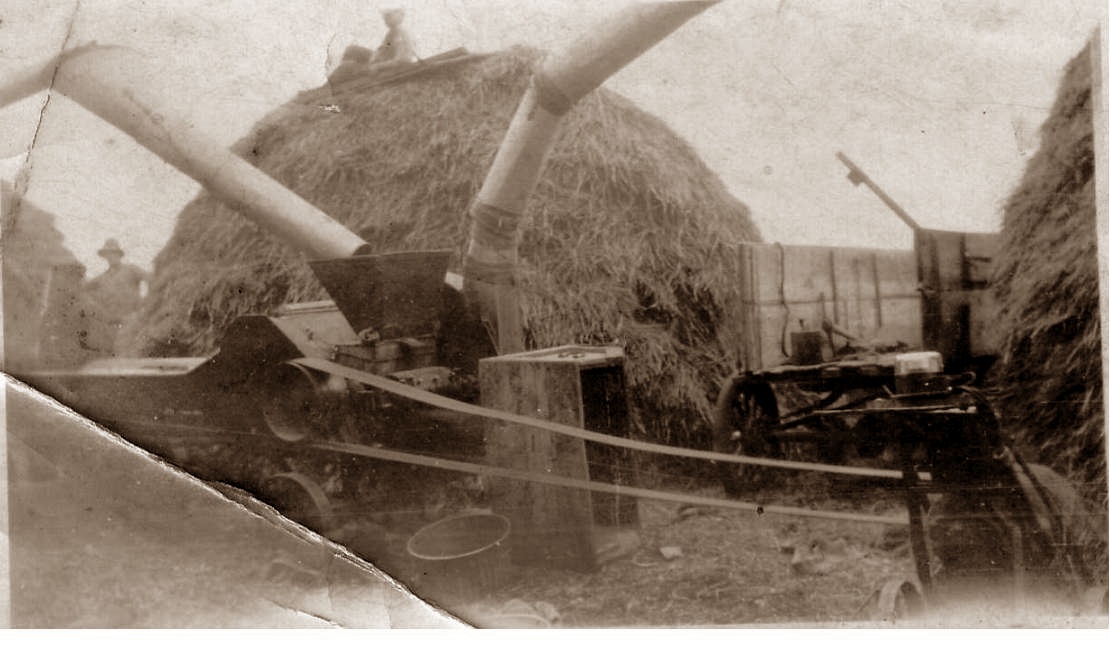
In the desk downstairs that belonged to Grandpa Janson (the one we were not supposed to touch),  I found this photo of some sort of harvest-related activity--theres a hopper, and a belt, and two large taped-together tubes like stove pipes going left and right.  Were they shooting out those piles of straw?  And, was that an electric generator (lower right)?
::::::::::::::::::::::::::::::::::::::::
When I asked mom about it years later, she said it was the Janson farm, and grandpa was trying to prove that farms could definitely be electrified--not only lights in the house and barn, but also this kind of thing--silo filling, shredding,  feed distribution, milking and milk handling, barn cleaning-- there were endless possibilities.  She said Grandpa worked with the power company to get an electric line strung to his farm, and proved that electricity was not dangerous.
Stearns REA history

Minnesota Power & Light history

Hm.  It only takes a little research to discover this was almost certainly a crock.  Once towns and cities had it, farmers were begging for electricity.  What other  occupation but a farm took quite so much back-breaking labor every day?  Check this article from Popular Mechanics called "Electricity to end Farm Drudgery".  WHAT farmer wouldn't want less labor?  And even without electricity, farmers had used steam power for bigger tasks like threshing for years.  Besides, grandpa's farm was 17 miles from Little Falls.  If they'd wanted or needed a demo farm, there were plenty within a mile or two of the dam.  So, what was this a photo of?
Probably it was grandpa proving that he didn't NEED to go buy a big fancy piece of equipment like this one Larry found:
(I'd love to be proved wrong about our conclusions re: this cool family story, but.....)